Specorator

SPEC-DRIVEN, AGENTIC DEVELOPMENT

Specorator

A repository-native operating system for building with AI agents: specs first, role-scoped handoffs, quality gates, and traceable Markdown artifacts from idea to release.
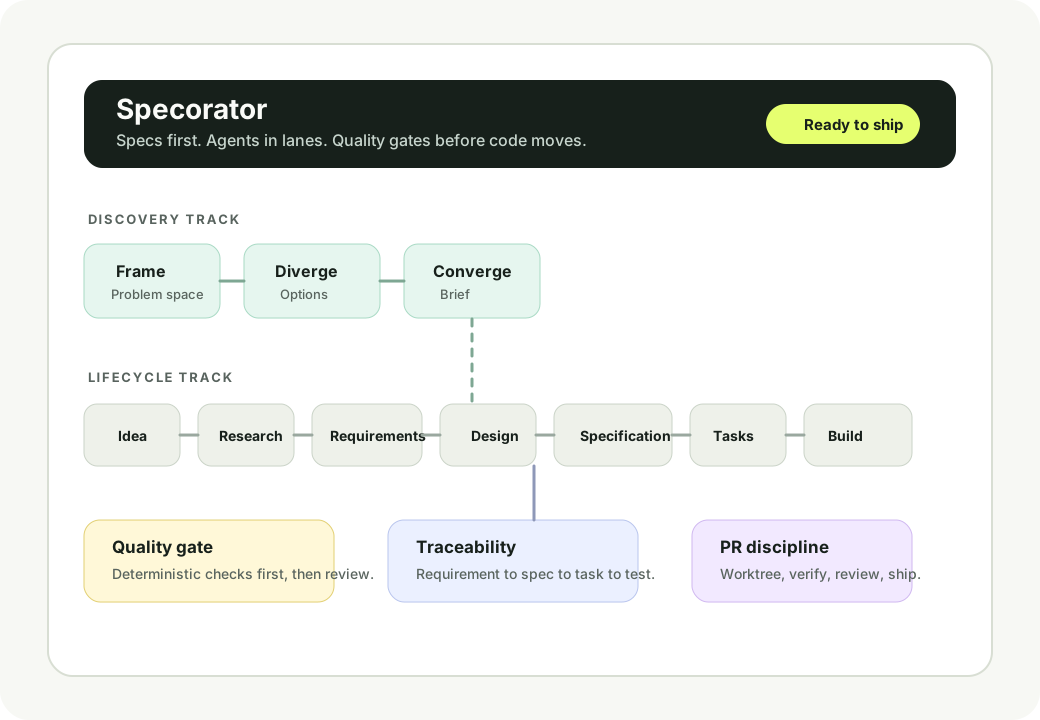
Specorator workflow map showing discovery, lifecycle stages, quality gates, traceability, and PR discipline.
11
Lifecycle stages
10
Constitution articles
14
Agent tracks

Workflow

Two tracks, one source of truth.

Discovery creates the brief. The lifecycle turns it into tested, reviewed, releasable work.

Lifecycle

11 stages

  1. 1 Idea Analyst
  2. 2 Research Analyst
  3. 3 Requirements PM
  4. 4 Design UX + UI + Architect
  5. 5 Specification Architect
  6. 6 Tasks Planner
  7. 7 Implementation Dev
  8. 8 Testing QA
  9. 9 Review Reviewer
  10. 10 Release Release Manager
  11. 11 Learning Retrospective

Tracker

What's being built.

Features sourced from issues/*.md in the repository.

Tracker data comes from local repository files. GitHub issue metadata is unavailable — no API snapshot was generated for this build.

Filter by status

User manuals

Install, initialize, and use Specorator.

Human-facing manuals are sourced from Markdown, with Obsidian-safe frontmatter and stable repository links.

Claude Code users active

Specorator Claude Code Plugin User Manual

End-user guide for installing, initializing, using, and maintaining the Specorator Claude Code plugin.

Read manual

Reviewed 2026-05-09

Reference

Decisions and language.

Every architecture decision and glossary term, sourced from the repository.

Architecture decisions

Glossary

ADR
A one-page record of an irreversible architectural decision — what was decided, why, what alternatives were considered, and what trade-offs were accepted.
Agent
An AI assistant specialised for one role in the workflow — analyst, PM, designer, developer, QA, reviewer, and so on.
agentic-workflow
agentic-workflow is the repository slug and GitHub Packages npm package identity for Specorator.
Artifact
A markdown file produced at a stage of the workflow — idea.md, requirements.md, design.md, spec.md, tasks.md, implementation-log.md, test-plan.md, test-report.md, review.md, release-notes.md, retrospective.md, and so on.
Discovery Track
A structured ideation mini-sprint — Frame → Diverge → Converge → Prototype → Validate → Handoff — used when there is no clear brief yet. Produces a chosen-brief.md that feeds Stage 1 (Idea) of the Specorator lifecycle.
EARS
A sentence format for requirements — *Easy Approach to Requirements Syntax* — that makes them unambiguous and 1:1 testable.
Quality gate
A short checklist a stage must pass before the next stage can begin.
Retrospective
A short look-back after every feature: what worked, what didn't, what to change next time.
Spec
A written description of exactly what to build — no ambiguity, no guessing.
Specorator
Specorator is the product name for this spec-driven, agentic software-development workflow template.
Traceability
The discipline of linking every piece of code back to a task, every task to a requirement, and every requirement to a test — so that any change can be reasoned about across the full chain.